PackDB for Enterprise
The same tenant-isolated, fully managed platform your developers can evaluate self-serve today — with security, deployment, and support terms scoped for procurement through sales.
Security and isolation
What the platform enforces today — not a roadmap.
Authenticated on every transport
HTTP, OTLP gRPC, and Flight SQL all run one auth pipeline: identity resolution, then explicit per-route policy enforcement. No route ships without a declared policy.
Tenant isolation by construction
Customer-facing credentials — tenant-scoped API keys and user sessions — are bound to your workspace's org id, and every query and ingest request is scoped to it. A mismatched tenant header is rejected, not reconciled.
Scoped machine credentials
API keys are issued by the control plane, bound to your workspace, and role-backed (reader, writer, admin) — with last-use tracking for key hygiene.
Per-user query attribution
Dashboard queries run as short-lived per-user tokens rather than a shared workspace key, so query activity attributes to the person who ran it.
Per-workspace limits and usage
Each workspace carries its own resource limits, quota enforcement, and a live usage envelope — visible in the dashboard, enforced at the platform.
Security review, with sales
Bring your security questionnaire and compliance requirements to the enterprise conversation — we scope what's needed rather than over-claiming here.
How isolation works
Isolation isn't a setting you toggle — it's how identity, requests, and resources are handled at every layer.
1. Bound when issued
Every customer-facing credential — a workspace API key or a user session — is minted by the control plane carrying your workspace's org id. Keys are role-backed (reader, writer, admin), not open-ended grants.
2. Resolved on every request
Metrics, logs, traces, or SQL — PackDB resolves the tenant from the credential server-side before touching any data. A request whose tenant header contradicts its credential is rejected, not reconciled.
3. Enforced per workspace
Your workspace runs against its own resource limits and quota, with a live usage envelope in the dashboard, so every tenant's ingest and query load is bounded by its own envelope. Endpoints are shared per environment; the workspace binding travels with the credential.
The same platform your developers can evaluate today
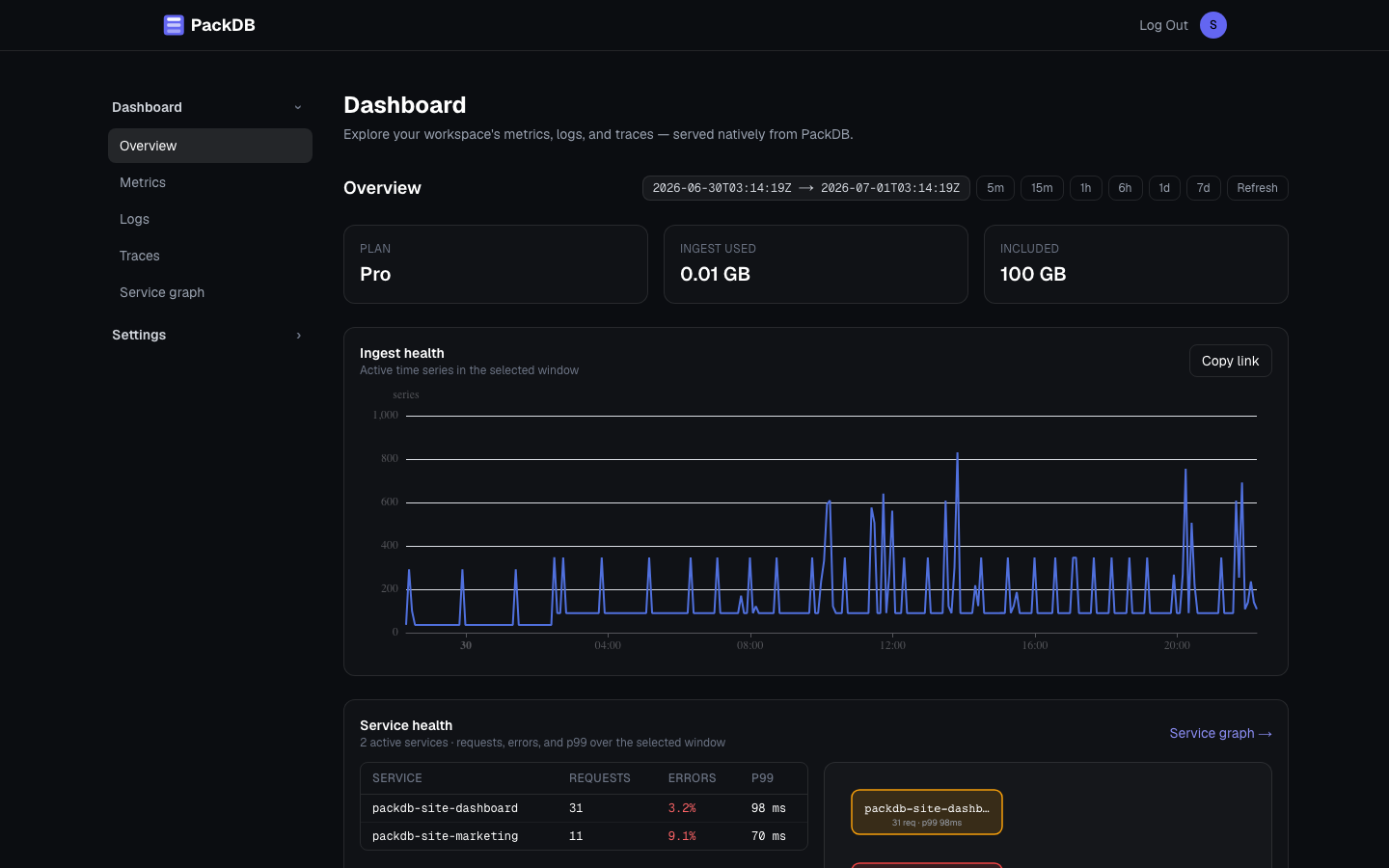
Enterprise terms wrap the product you see here — unified metrics, logs, and traces with a native explorer and Grafana-compatible datasources. Evaluation starts self-serve; enterprise controls are handled with sales.
Adoption path: send telemetry · keep Grafana · deployment model
One supported deployment model
Fully managed cloud
There is no database for you to deploy, scale, or operate. PackDB runs storage, indexing, query, and retention; your side is whatever already produces telemetry. Each workspace is an isolated tenant with its own API keys and resource limits. Read the deployment model.
Beyond the default, with sales
A dedicated cluster, a specific region, or a private networking arrangement are handled as enterprise engagements rather than self-serve — scoped to your requirements in the sales conversation, not promised generically here.
Support envelope
Self-serve plans
The free self-serve evaluation is self-supported with the docs and troubleshooting guides; Pro includes email support. Both are stated on the pricing page — nothing hidden behind a call.
Enterprise and design partners
Support terms — response expectations, escalation contacts, onboarding — are scoped in the contract, sized to your environment. We put boundaries in writing instead of quoting blanket guarantees on a marketing page.
Evaluate before you commit
Prove the platform against a real workload before procurement ever starts — on your own timeline, with no strings.
Working product surfaces, not a mock demo
The free self-serve evaluation includes the same explorer, Grafana-compatible datasource types, and query surfaces used under contract. You evaluate those working surfaces, not a mock demo.
No credit card, no sales gate
Sign up and send telemetry the same day. Talk to sales when you're ready to scope terms — not as a precondition to trying it.
What you prove carries forward
The query surfaces and Grafana-compatible datasource types are identical under contract, so the queries and dashboards you wrote during the evaluation stay valid. Workspace layout — and the keys your collectors and datasources point at — is scoped with sales.
How procurement works
1. Evaluate self-serve
Start on the free self-serve evaluation — no credit card, no sales gate — and prove the platform against a real workload.
2. Scope with sales
Security review, deployment requirements, support terms, and commercial terms — enterprise pricing is custom, stated as such on the public pricing page.
3. Contract and onboard
Terms land in the contract, and the production setup — workspaces, keys, and retention — is scoped alongside them. Our privacy policy is public.
Procurement and security FAQ
- Can we run a security review before committing?
- Yes. Bring your security questionnaire and compliance requirements to the enterprise conversation — we scope against your environment rather than publishing blanket claims here.
- How is our data isolated from other tenants?
- Every customer-facing credential is bound to your workspace, and every query and ingest request is scoped to it server-side; a mismatched tenant is rejected. See “How isolation works” above.
- Where does our data live — can we pick a region?
- The default is the managed cloud on shared per-environment endpoints. A dedicated cluster, a specific region, or private networking is an enterprise engagement, scoped with sales rather than promised generically.
- What does enterprise support cover?
- The free self-serve evaluation is docs-supported and Pro includes email support (both stated on the pricing page). Enterprise support terms — response expectations, escalation contacts, onboarding — are written into the contract, sized to your environment.
- How does enterprise pricing work?
- Free and Pro pricing is public on the pricing page. Enterprise is custom, scoped with sales alongside your deployment and support terms.
- Can we try it before we buy?
- Yes — the free self-serve evaluation includes the live explorer and query surfaces, with no sales gate. Prove them on a real workload first, then bring the results to procurement.